Your money stays linked to the index you choose — the S&P 500 or the Nasdaq 100 — held as real positions in your own account and in your own name. Real, paid-for options are designed to set the worst you can do in any one year.
Whether you are holding cash, or already fully invested and looking for protection.
We buy shares in the index you choose — the S&P 500 or the Nasdaq 100 — and they sit in your own account, in your own name. You own them and you collect the dividends. Then we place the protection around those shares, so it is in place from the first day. You pick the index, the protection and the term before anything is bought.
We don’t touch the shares you have. You keep them and you keep the dividends, and because nothing is sold, the gains you’ve been carrying keep deferring. We simply place the protection around what you already hold. The only thing that changes is that your fall now has a bottom you chose. The one exception is the 0% Floor: it is built from cash, so funding it from shares you already own means selling them first — every other floor keeps your shares, with no sale.
 Watch the overview1:46 · how the program works, start to finish
What the protection actually is, what it gets you, and how it’s paid for — without the jargon.
A small piece of the money already in your account — usually a few percent — buys an option, and that one option covers the whole account for the term you choose. In return, the first part of any rise replaces the money that bought it — after that, the gains are yours.
A contract, bought on an exchange, that pays you if the market falls below your level. The same instrument pension funds use to hedge.
You buy the protection and hold it. Nothing is sold short, nothing is borrowed, and nothing is bought on margin.
It buys the option, on an exchange, at the market price — so it leaves as cash and comes back as the protection you hold.
No cap, unless you choose one. Once the market is past the point where your payoff begins, there is no ceiling on what a rise is worth to you.
Every structure starts from the same idea: a known worst case. Each then trades that certainty for a different kind of upside.
A hard stop. You cannot fall below the level you choose. Your upside is not capped, unless you ask us to cap it. A small piece of the money already in your account — usually a few percent — buys the protection. The first part of any rise replaces the money that bought it; after that, the gains are yours.
An everyday cushion rather than a hard stop. The first portion of any loss is absorbed for you. If the fall goes deeper than the cushion, you take the loss only on the part beyond it. For example, with a 20% cushion, a 25% market fall would leave you down 5%. Your upside is not capped, unless you ask us to cap it.
This one is real. It happened to a man three years from retirement. In the 2008 crash the fear got bad enough that he sold near the bottom, and a year later he bought back in, higher. That single decision cost him about a third of his savings, permanently, and he worked roughly ten more years to make up for it. Most people don’t lose money in a crash because the market fell. They lose it because they sell at the bottom and then can’t decide when to get back in. A defined floor is designed to keep the drop shallow enough that panic-selling is far less likely.
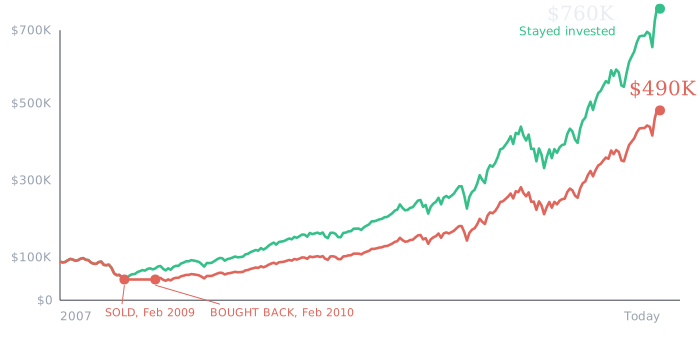
That’s what panic costs. A floor is designed to keep the fall shallow enough that you never face that decision.
Three real crashes, real market data. The market plunges, your floor stops the loss, and when the market climbs back, you climb with it.
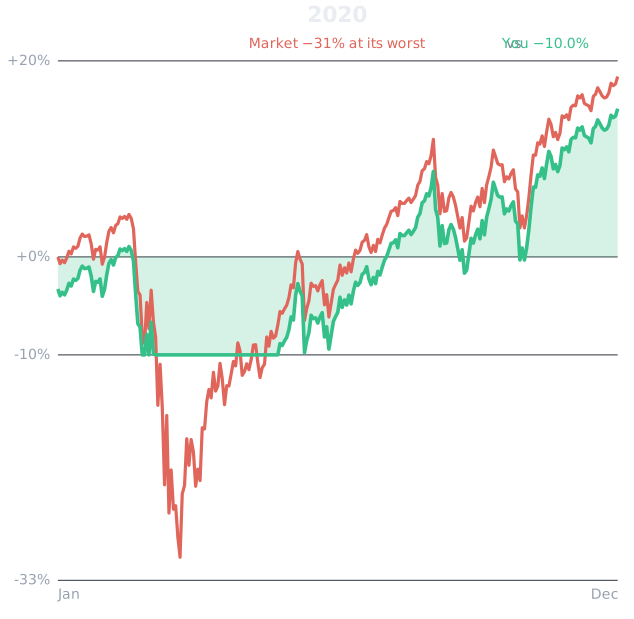
The market fell about 31% in five weeks, then finished the year +18.4% with dividends. Your −10% floor held through the fall, and because nothing here is capped you kept the recovery: +15.1% on the year, for a fraction of the ride.
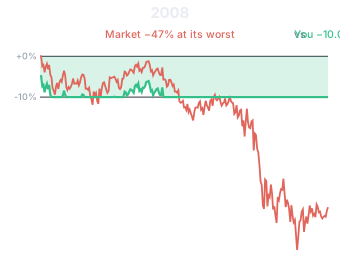
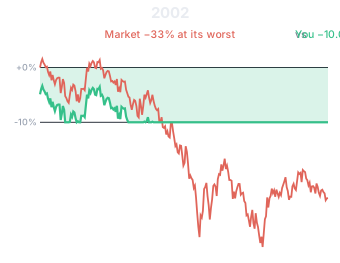
Real daily S&P 500 data and real option-chain pricing. These panels show what the index did and where the floor sat while it did it — they are not an account’s results, so no return is being claimed and no fee applies. Illustrative of the −10% Floor; the same mechanics apply at −15% or −20%. Past performance and hypothetical results do not indicate future results.
Grow with the market. Relax through the crash.
−10%. −15%. −20%. On the Floor, that level is as far down as your result is designed to go. On the Buffer it is the first slice of loss absorbed for you. Below it you fall with the market again. Either way it’s your choice, not a market outcome.
You hold real positions in your own account — shares in an S&P 500 or Nasdaq‑100 index fund — and we buy protection on the index, traded on a public exchange, and hold it over them. Think of it as insurance that stops your losses at the floor you chose; a Buffer cushions the first slice instead.
The protection is not bought with your cash. It is paid for by selling one band of the recovery just above your floor. The band runs from the level you chose up to the point where your gains start again. That band is what you give up: if the index finishes inside it you receive your floor rather than the recovery. Above the top of it you keep every further dollar the market rises, with no cap unless you choose one. So there is nothing to send us, nothing to buy, no policy to apply for and no paperwork to sign. You place no trades; we place all of them. From that moment the shape of your year is written into the contracts themselves.
The floor you choose never moves. What moves is where your payoff begins. The protection is priced to market conditions, so a jittery market starts you a little further up than a calm one. Deeper floors begin sooner because there is less to insure. Once the term is placed, both the floor and that starting point are fixed.
Once the trade is placed for the term, your result stops being a forecast. From that instant it depends on exactly one thing: where the market ends the period. Every possible ending already has a locked answer.
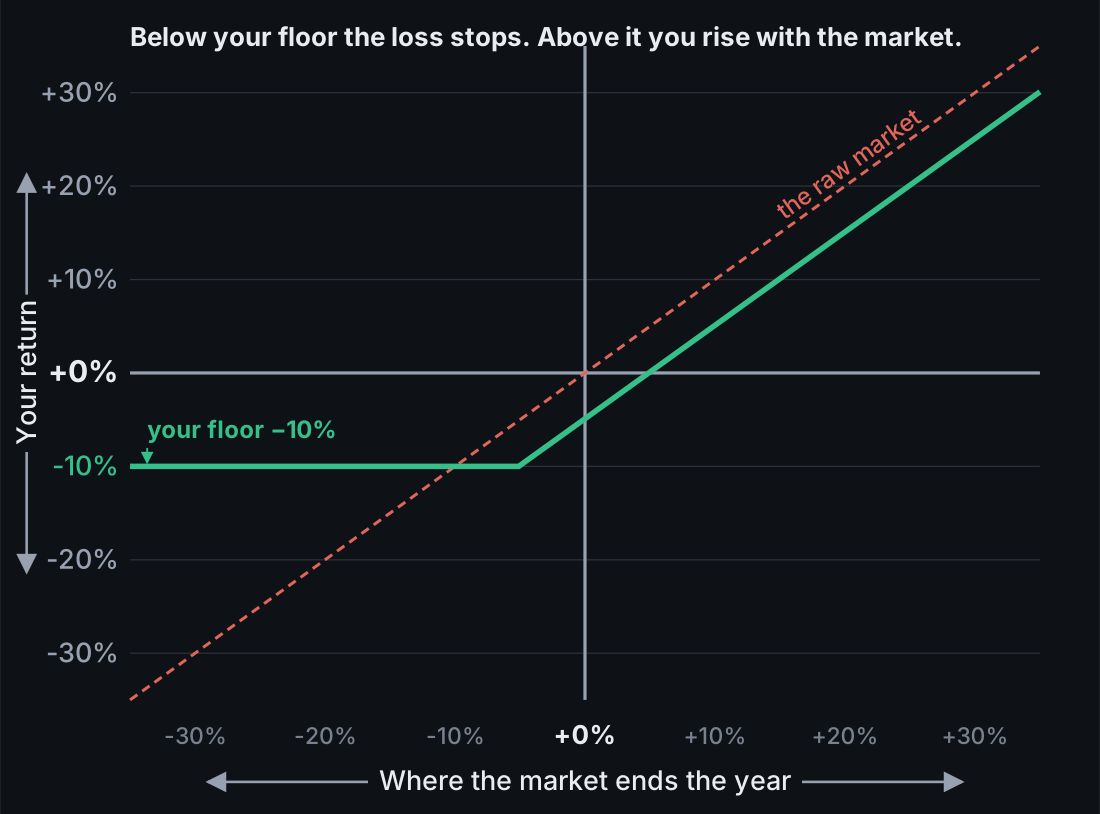
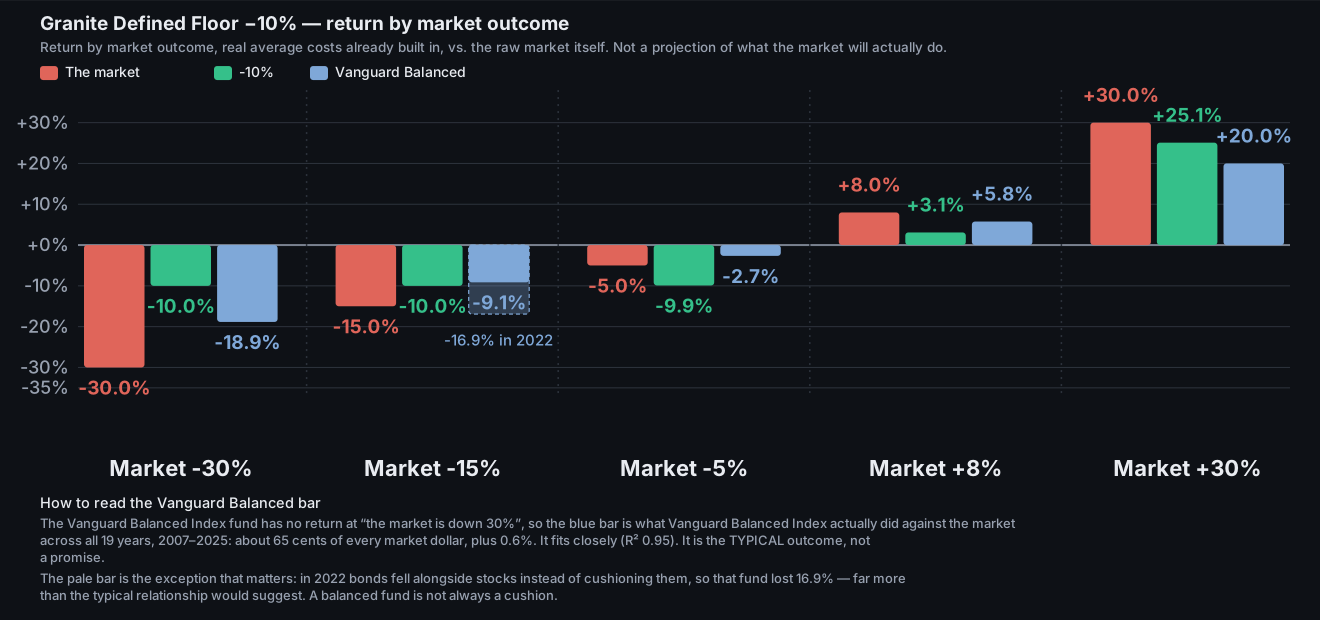
It is an answer key, set the day we enter and fixed for the whole term.
This is not a fund, not a pooled vehicle, and not a transfer to a new custodian. Granite never takes custody of client assets.
Real holdings in your own brokerage account — index-fund shares, together with the protecting options. Not a claim on a fund. Not an IOU from a bank.
Granite is not able to withdraw, wire, or transfer funds out of a client account under any circumstance. Your custodial relationship doesn’t change at all.
The options are bought and sold on a public exchange, and the Options Clearing Corporation stands behind them. It has never failed in its history. There is no one company whose failure erases your protection.
Every position is a real security in your own account, not a fund share and not an IOU on a bank’s balance sheet. You can get out whenever you want — there is no penalty for leaving, and nobody hands you a marked-down price to go.
The outcome you choose is delivered at the end of the term, so the program is built to be held that long.
That is the whole point of the structure, and it is the question we are asked most. The floor is measured at the finish, so holding to the end is the one thing asked of you. Do that, and the level you chose, before fees, is as far down as your result can go. What you see in the meantime is a market price, and it can sit under that level along the way.
Every Granite program is defined this way. Whatever the market does, the answer for that ending is already written, and you read it off the graph we quote you before you commit. A Buffer in a market down fifty percent has an answer just as exact as a Floor does. What differs between the programs is how far down the answer goes. A Floor stops at the level you chose. A Buffer absorbs the first slice of a fall and then follows the market down from there. Defined is not the same as limited — the graph is what shows you which one you are buying, and the three cards below are about the Floor.
Not on a Floor held to the end of its term. The protection is a contract held in your own account. When the term ends it pays whatever the fall below your level came to — so the level you chose, before fees, is how far down the answer can go. Where the market ends decides the rest of it.
Until the term ends, your account is priced at what the market would pay for those positions today, and part of what the protection is worth is only delivered at the finish. So in a hard fall you can open a statement showing less than the level you chose. That is the position on its way to its result, not the result. Nothing has broken — it only becomes a real loss if you sell while it is there.
Every position is a real security in your own account, in your name, at your own custodian. You are not locked in for a set period, we charge you nothing for leaving, and you can ask to withdraw at any time. Taking part of it out means selling some of the positions, which changes the protection on what stays behind — so we would walk you through that before you did it.
Sell before the term ends and you get what those positions are worth on the day, which can be less than the level you chose. That level is measured at the finish, and that is when it applies. This suits money you can leave in place for the term.
We put this here so that when you open a statement, you recognize everything on it. There are four things. That is the whole list, and every one of them is bought on a public exchange and held in your own name.
Which fund and which contract you get depends on the index you pick — the S&P 500 or the Nasdaq‑100 — but the shape is the same either way: you own the shares, and index option contracts sit over them. Which contracts, and how many of each at today’s prices, is on the calculator. The sizes move with the market, so we do not print them here.
The biggest line on your statement, and the whole of your exposure to the market. You own real shares in an index fund. Six funds qualify, and they are the ones most people already hold: for the S&P 500, SPY, VOO, IVV or SPYM; for the Nasdaq‑100, QQQ or QQQM. If you bring in shares of one of them, we floor the shares you have; if we are buying for you, we buy SPYM or QQQM. They are yours, they are in your name, and you collect the dividends. On tax they behave like any other shares you hold: dividends are taxed as they arrive, and a gain or loss is counted when they are sold.
This is what pays you if the index finishes below the level you chose. We buy puts on the index itself — XSP, the Cboe Mini‑SPX, on the S&P; XND, the Nasdaq‑100 Micro, on the Nasdaq. Both settle in cash on one set date, and nobody can call them in early. On tax these usually get a fixed split rather than one that depends on how long we held them: 60% counted as long-term, 40% as short-term.
This is how the protection is paid for, and it is why you hand us no cash for it. We use calls on the same index and the same finish date to give up a defined stretch of the recovery just above your floor. That stretch is what you give up in return: if the index finishes inside it you receive your floor, not the recovery. Above the top of it you keep every further dollar the market rises. Same kind of contract as the puts, so the same tax split.
Protection is only sold in whole contracts, so it rarely fits your account to the dollar. The remainder goes into a Treasury bill fund, where it earns interest while it sits. That part does not follow the market, and the floor does not cover it — a fund that holds Treasury bills is not itself a government obligation and carries no government guarantee. Your quote shows the exact figure before you agree to anything.
A word on the tax split, because it is the part most easily misread: it is the treatment those contracts generally receive on their own. Holding them alongside shares — which is exactly what this structure does — can change it, and what any of it is worth to you depends on your circumstances and the type of account you hold. That is a conversation for your adviser and your accountant, and it is worth having before you start.
How many option legs a block of protection has depends on the shape you chose. A Floor is a put bought at your level, and, when a band is sold to pay for it, one call sold and another bought further up so the amount given up is defined and cannot run away — three legs. A Buffer’s protection is a put bought at today’s level and another sold at the buffer level, plus the same band — four. A shape with no band sold has fewer. Your quote lists the exact legs. Every one of them is a Cboe index option. XSP is the Mini-SPX, designed to be one tenth of the full S&P 500 contract and settled in cash off that day’s closing level; XND is the Nasdaq-100 Micro, one hundredth of the full Nasdaq-100 contract. The fixed 60/40 tax split is section 1256 of the tax code, under which open contracts are also marked to market at each year end. Section 1256 can be modified by the straddle rules where index options are held together with ETF shares — which is this structure — and that is why the treatment above is described as the general one rather than as your result. SPYM is the State Street SPDR Portfolio S&P 500 ETF; it was called SPLG until October 2025, same fund. QQQM is the Invesco Nasdaq-100 ETF. Options on those two funds are equity options rather than index options, so the 60/40 split would not apply to them, and one that had been sold could be turned into shares before the date it ends — we never sell an option that could take your shares away from you. The same reasoning rules out options on SPY, IVV and VOO: their contracts are the same size as XSP, so they buy no extra precision, and they would give up the 60/40 split. What one of each piece is worth today, and why the term runs a little past a year: why the sizes and the terms are what they are.
Nearly every client asks a version of the same question: if I just bought the market and left it alone, I’d pay no tax until I sold — so why take something that counts a gain every year? It is a fair question, and this is the honest answer with the numbers attached.
Before any of the tax makes sense, it helps to know what is actually sitting in the account. There are only ever two pieces: a big steady part, and a small part that does the protecting. There are two ways to build them, shown in the two panels below. Nearly every client gets the first one, a Shares Base — you own the index fund and we put a floor under it — and everything on this page after the panels is written for that client. The second one, an Options Base, is for one situation only: you already own index-fund shares that have gone up a lot since you bought them, you want to keep them, and you want the 0% Floor. Putting a full floor directly under shares you keep can count, for tax, as if you had sold them — which would make the whole gain taxable at once. So we do the opposite: your shares stay exactly where they are, untouched, and the floor we build alongside them holds no shares of its own. Those are two separate things — the shares you own, and the structure we build next to them — so both being true is not a contradiction. Which build you get is decided by what your shares originally cost you, not by preference. Where the tax rules can honestly be read more than one way, we take the cautious reading and build as though it is the right one. We put that choice in front of you and your adviser, in plain words, to check off when you apply, before anything is bought. The decision is yours and your adviser’s, not ours. We do not give tax advice.
You own the market, and we put a floor under it.
You own the floor itself, and we add the market on top.
The 0% Floor is built from cash, not from shares. We hold a steady, interest-bearing position that returns your principal by a set date, and buy one call that gives you the market’s rise. The call takes the place of owning shares — so this structure holds no shares of its own.
Anyone can choose the
0% Floor — the one thing to know is how you fund it:
• Coming in as cash (or new money): we build it directly. Simple.
• Coming in as shares that have gone up: you’d have to sell them first to fund
it, and selling appreciated shares is a taxable event. We can’t just put a 0% floor on shares you
keep — fully protecting shares you already own can be treated by the IRS as if you’d already
sold them (a “constructive sale,” section 1259), taxing the gain now anyway. Either way the
gain is taxed; the honest path is to sell and rebuild inside the floor, eyes open.
This is a tax judgement, not tax advice — take it to your own accountant.
Either way, you finish with the market’s growth and a floor beneath you. The difference is only in which piece does which job — and that is worth holding on to, because it is the one thing everything below depends on. On a Shares Base the big part moves and the small part pins the bottom. On an Options Base the big part holds the bottom and the small part moves. Same result, built the other way round.
And that is where the tax comes from. Shares are only counted when you sell them, so a Shares Base can wait. The options that make up an Options Base are counted every year by law, sold or not — which is the whole of what follows.
If you own shares and never sell them, nothing is counted; the gain rolls forward and you settle up once at the end. Index options are different. They are counted every 31 December whether you sell them or not — that is the law, not a decision we make. Everything below follows from that one difference.
Every route below earns exactly the same before tax, so the only thing separating them is the tax itself. These are the top federal brackets; your own rate may well be lower.
Market returns only count if you don't sell. We make sure you don't.
California has no special rate for investment gains — it taxes them like salary — and it ignores the favorable federal treatment index options receive. That takes the blended rate on an Options Base from about 31% to about 44%.
| Route | Federal only | California | Cost of the tax |
|---|---|---|---|
| Inside an IRA | $793,042 | $793,042 | nothing |
| Just hold the market | $663,798 | $591,573 | — |
| Our product on a Shares Base | $657,502 | $587,674 | $6,296 / $3,899 |
| Our product on an Options Base (0% Floor only) | $562,259 | $482,987 | $101,538 / $108,585 |
| Where it’s held | Tax that year | Why |
|---|---|---|
| Inside an IRA | $0 | Nothing inside the account is taxable |
| Our product on a Shares Base | about $450 | Dividends only — none of the $10,000 gain |
| Our product on an Options Base (0% Floor only) | $3,060 | The whole $10,000 gain is counted on 31 December |
When markets fall, the protection gains value, and that gain is counted even though you have not cashed it in — so you can write a check in a year your account went down. That is the honest downside. It is partly recoverable: a later loss on those contracts can be carried back up to three years.
Shares hedged from day one lose their long-term tax status, so the final bill comes at the higher rate. Fixing that means holding them unprotected for a year, either before the protection starts or after it ends. That unprotected year is a real risk and it should be a deliberate decision.
There is no way to defer it, and it is not a choice we are making: index options are counted annually by law. Over fifteen years that is about 15% of the outcome federally, 18% in California.
Your floor comes from an instrument that matures to a known sum — arithmetic, rather than a hedge that has to work. No holding-period traps, no lost dividend treatment, no unprotected year. And it is the only way to build a floor that protects everything you put in.
If you have an IRA, the product belongs there. The tax question disappears completely and you keep the floor. Nothing on this page applies to you.
Bringing in stock you have owned more than a year, we hedge it where it sits. We never sell it, so your gain keeps deferring — and the tax cost of adding the protection is close to nothing.
New money carries no built-in gain, so nothing about it can count as a sale for tax, and we hold real shares. The one thing to weigh is the holding period: hedging shares from day one costs their long-term rate, and fixing that means a year unprotected at one end. We walk you through it with your own numbers before anything is bought.
If you are genuinely certain you would hold through a fifty percent fall without selling, then yes — you probably should, and we will tell you so. Most people discover they cannot. What you are buying from us is the ability to stay invested when it is hardest, and whether that is worth 1.25% a year is your call. We would rather you made it with the number in front of you.
The figures assume $250,000 over fifteen years at 8% a year, top federal brackets including the 3.8% investment surtax, and top California rates where shown. Every route is assumed to earn the same before tax so the comparison isolates tax alone, and advisory fees are excluded from all of them. Your own outcome depends on your bracket, your state and your holding period. This is not tax advice — Granite Capital is not a tax adviser, and anything here is worth reviewing with your own accountant before you act on it.
Capital that has to be there in five years. You still want to own the market’s growth — you just can’t accept a fall with no bottom to it.
The order the good and bad years arrive in is the real enemy. A known floor changes what a bad year does to a withdrawal plan.
Out of the market and waiting for a signal that never comes. A defined floor is a way back in with the worst case written down in advance.
The investor who is genuinely certain he would hold through a fifty percent fall without selling. If that is you, you probably should just own the index and leave it alone — and we will tell you so. What you are buying here is the ability to stay invested when it is hardest. If you would never have sold anyway, you are paying for something you already have.
It is written into the option contracts themselves, not projected. On the day we enter, we buy real, exchange-listed protection on the index against the positions you hold. From that moment your worst case for the term is fixed, before the market has any chance to move against you. Being honest about the language: this is a structural floor, not an insurance guarantee or a promise from Granite. It is designed to deliver its outcome when held to maturity.
Not your upside. On the Floor and the Buffer there is no cap unless you choose one. Nothing is sold off to pay for the floor. What it asks is that your payoff begins a little way up. The protection is bought up front from the cash already in your account, so you start making money once the market is up by roughly that much. You send us nothing, buy nothing, and apply for nothing. It works like insurance in how it is priced, but there is no policy to write and no application: we place every trade for you. A deeper floor begins sooner, because there is less to insure. We quote no figure for it here because it is priced to the market on the day and is different every term — you see your own exact number, priced live, before you commit.
For the same reason insurance does: it is priced to conditions, and conditions change. That price is what sets how far up your payoff begins — when the protection is more expensive, a wider band of the recovery has to be sold to pay for it. It is always settled that way, never out of your pocket. When markets are jittery your payoff begins a little further up; when they are calm, it begins sooner. The level you chose never moves, only where your payoff starts. We can give a solid estimate a few days out and a tighter one the morning we enter. The instant we are in, both the floor and that starting point are locked for the whole term.
It is built to be held to the end of the term — that is when the outcome you chose is delivered. Your money is not trapped: every position is a real security in your own account. There is no penalty for leaving, and nobody hands you a marked-down price to go. But selling early means selling at market, which can be worth more or less than the designed floor. This suits capital you can leave in place for the term.
You do. The shares and the options sit in your own brokerage account, in your name, at your existing custodian, Granite never takes custody and cannot move money out. The options are exchange-listed and cleared through the Options Clearing Corporation rather than carried on any one firm’s balance sheet. If Granite disappeared tomorrow, there would be nothing for you to do. What protects you is the positions themselves, not us: they are already in place, they are already yours, and at the end of the term they settle on their own terms, exactly as designed.
Three differences that matter. You own real positions rather than an IOU from a bank or a share of a pooled fund. Your terms are quoted off live option markets and built around the level you choose, rather than picked from a product shelf. And most notes and buffer funds cap your upside by default, which can take a large bite out of a strong year. On the Floor and the Buffer a cap is yours to choose, not ours to impose.
As a general guide, most accounts over about $20,000 can use the Defined Outcome program. It fits most naturally once the account covers a whole standard piece, and more comfortably above that. The pieces are bought whole, so an account that covers one or two of them leaves very little sitting in cash. The size of a piece moves with the market: why the sizes and the terms are what they are. There is no fund minimum to clear. A few choices ask for more — the Nasdaq version is bought in whole index contracts, so it starts a bit higher (roughly the price of one such contract), and a defined buffer or a full twelve-month term suits a larger account. We will walk you through exactly what your account size supports on an introductory call.
Four roles cover everything that touches your money — compliance, client relations, the programs themselves, and the trading desk. These are the people who lead each one.

An investment adviser representative, Darren owns the firm and carries the compliance responsibility for it. He keeps the back office and the compliance side running.

Darren’s brother, and the person you will actually talk to. Onboarding, transactions and the day-to-day questions all come to Ryan.

An investment adviser representative and the founder of Granite Capital. Dave works on research and development — the programs themselves — and steps into the trading role whenever it is needed.

Dave’s daughter, an investment adviser representative, and the lead trader running the Granite Trading Desk. Your orders are placed at her desk.
Between them they handle the details, so what reaches you is clear communication, careful operations and a steady process.
Tell us the outcome you want and we’ll build it around your account, at the size and date you choose.
Schedule an introductory call